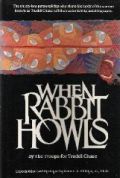
When Rabbit Howlsby the Troops for Truddi ChaseReview by Jay Young and Anthony Temple
|
 |
I can give you twenty more, all in conflict with each other.
They all belong to me and none of them belongs to me....
In speaking about Truddi Chase, let's put one thing aside right now. Most reviewers say that the abuse they describe is "hard to believe". Not to us. Every word the authors wrote about the physical, sexual and emotional abuse they went through is literally true. People are capable of doing all kinds of things to one another, not just to children. We can even accept that their multiplicity was caused by the abuse, as they state it was, although we have reservations as always about that. There's a lot of grey area on whether multiplicity is really caused by child abuse. For example, Billy Milligan was multiple before his stepfather got to him. But if the Troops say there was one person before, and the others started to appear only after the stepfather's sickening deeds, that's enough for us.
The story is difficult for outsiders to verify because of changed names and other identifying details, but according to Oprah Winfrey, a Washington Post reporter successfully located the entire family. As you might guess, the stepfather denied everything, but the brothers and sister confirmed that the whole story was true. Their only concern was that the book omitted so much, such as the fact that their mother had done some sexual things to Truddi& also (reported by Phil Donohue during his interview with Truddi&). Their mother died just before the book went to press.
We also have from an unnamed source the fact that the book was somewhat longer before it went to press, and that some information about Truddi&'s family and about Ean was cut, not because it was unbelievable, but because it would have made the book too long. We assumed that Truddi& would have placed this information in their next book.
When Rabbit Howls was a group effort, but either they don't have very distinctive writing voices or someone has made an effort to smooth things over and make the narrative less messy -- possibly the same person who confesses herself appalled by the many handwritings in the group journal. The book is uneven, but no more so than any other first effort. There are passages of deeply realised beauty and powerful imagery, and moments that fall flat with a resounding clunk, but many seasoned singlet authors have those -- Toni Morrison comes to mind.
Unlike most popular accounts and professional case histories of multiple personality, Chase&'s story does not involve buried memories of child abuse which were only recovered after she went into therapy. The opening chapters reveal that Chase (or rather, "the woman" -- the front, host or presenting self -- on behalf of one or more persons in her group) entered therapy for issues they specifically related to child abuse. In fact, in the first chapter, one of several vividly drawn fictional characters presents facts illustrating the real message of When Rabbit Howls: mental health professionals and law enforcement take child abuse and its consequences seriously, but not seriously enough. For example, Chase& initially asked for a therapist who specialised in issues arising from child abuse, but were told that there was no index listing doctors by specialty. They managed to get a referral to Dr. Robert Phillips from A Woman's Place, a gynecological clinic run entirely by women doctors.
The initial interview is recounted in the next chapter. Without benefit of hypnosis, drugs, or any hinting around on Phillips' part, "the woman" described feelings of fear, anxiety, exaggerated startle responses and other conditioned reflexes which made it difficult for them to work (they owned a commercial real estate business, which they later lost to the S&L scandals during the Reagan admin). She& also stated that her stepfather had "fondled" her (this term is used all the way through the book as a euphemism for masturbation) and asked if this could count as incest since he was not a blood relation. This does not sound like someone who has to be prodded into evoking memories. In an interview with Oprah Winfrey, Chase& stated "The memories were there. It's just that no one [in the system] could focus on them." Every time they tried to think consciously about any detail, they would experience blind panic, even scream and go into convulsions. In fact, if Chase& are describing their pre-therapy behaviour accurately, it sounds as if they were being affected not by repressed memories but by memories some of them were trying to forget and couldn't. (Most survivors of child sexual abuse report being unable to forget -- being unable to remember is less common.) What Dr. Phillips did, according to the book, was to provide the group with a holding environment, a place where they could feel secure about allowing "the woman" and the others to take out those memories and examine them in detail. Although he did use hypnosis for this purpose, we see no evidence that he coached them or led them to reveal anything; it came spilling out, they couldn't wait to tell him.
What was the Troops' therapy like? There is a difference between remembering intellectually what happened, and recalling exactly what took place and how it made you feel. (Readers of Elisabeth Kata's A Patch of Blue will be familiar with this phenomenon.) Many of the Troops who became involved in the therapy process were those who had experienced abuse personally (had been at front when it occurred), or who cared for and supported those who had been abused. Their memories were often sharp and clear, full of idiosyncratic symbolism and deeply felt emotion. One gets the impression that "the woman" may not really be only a mere shell through which the others express themselves (what many groups call "the front"), but perhaps a person in her own right who has simply shielded herself, and been shielded by others, via a number of elaborate psychological mechanisms, from the emotions of the past. Of course it would be traumatic for her to acknowledge the other people in the system; they bring their life histories and feelings with them when they evidence, and she'd have to remember not only what happened (of which she was already generally aware), but how it felt. The book contains a number of vivid descriptions of what these detailed memories are like and their physical and emotional effect.
This is not the recovered memory therapy advocated by books like The Courage to Heal -- with their McCarthyish assertions of child molestation behind every pat on the ass. This is not a case of parts of a single consciousness being named by a doctor, evolving into an apparent case of multiple personalities that then have to be put back together. Chase& were multiple long before therapy, and we suspect the multiplicity existed before the stepfather came into their life, though both Chase& and Phillips believe that the abuse was what caused a single mind to 'fragment', or as some of the selves put it, to give birth to other minds. The narrative is much more about the abuse than it is about being multiple, and that's as it should be. Still, it is necessary to examine the impression of multiple personalities that readers will receive from this book.
Some of the Troops communicate effectively with each other using what they call thought transference. Some know all about each other; others don't realise that they're not alone, and find out about it during the course of therapy. Some, like the Weaver or the Buffer, have specific tasks involving the deflection of memories away from conscious recall. Others, like the Junkman or the Collector, have their own motivations, mostly to do with creative pursuits. They are affected by the abuse, but were not created to deal with it.
The group has an operating system, and it worked effectively enough for them to own their own real estate firm. They sold that company only because the S&L scandals of the late 1980s caused huge losses in commercial real estate. They were able to find employment in a variety of other fields (commercial art, legal secretary) with relative ease. They were the first group in the popular literature to demonstrate that being multiple does not mean being a dysfunctional basket case (certainly an inspiration to us). Although many of them have little or no access to a consistent record of memories and they can appear scattered as a result, they demonstrate the use of notes and lists. Their only failing is a tendency to inappropriate switching, such as when the ebullient Miss Wonderful appeared at the end of a real estate transaction and snuggled up to the seller. Some of them have anxiety or panic attacks, others have depression. However, it's made clear that the group has been operating this way for years and were still able to manage successfully.
When Rabbit Howls was not the first published book about multiplicity written by a multiple client rather than a mental health professional, not even the first in modern times. But unlike earlier books, it contained a number of items generally left out by singlet "experts". The Troops defied their doctor's attempt to classify them, instead describing system members in terms of a cooperation of equals -- not pigeonholed as to function, boxed and labeled like an assortment of bacteria (thank you Shandra). They were the first describe co-running, two or more selves operating the body at the same time -- and co-presence, two or more selves up front and observing the world-at-large at the same time. (They did not use those terms, which appear to have been invented sometime in the early 90s, probably by Dr. Richard Kluft.) They were the first to illustrate that the presenting self -- the one most people think you are, often the one who initially presents for therapy -- need not be the original or firstborn child. They were the first to use the term "frontrunning". They were the first to confirm to the public that persons in a multiple system could be a different race or ethnicity from that of the body. All of these things must have been known in the mental health world for some time, but it was not in the popular literature. The Troops were also the first to describe subjective time (a few minutes to one person might seem an hour or so to another -- "that song on the radio should have ended long ago"), and give readers a look at a subjective, personal world and how it interfaced with the world-at-large. They dismiss the use of checklists to determine multiplicity as unrealistic given the wide variety of multiple experiences. They assert that no two multiple groups or systems are alike, and should not be expected to be.
Most important, the Troops were the first multiple system in either the popular or medical literature to refuse integration and to insist on continuing to operate successfully as a team. People who experienced multiplicity, but did not resemble Sybil, must have been greatly comforted and inspired by all of this. They were really multiple, after all -- just colouring outside the lines. And they did not have to integrate.
Unfortunately, this was also one of the first published books to perpetuate a damaging myth. This was accomplished through an ingeniously subtle writer's trick. We didn't spot it at first -- one of our correspondents did. How many other people have overlooked it and believed that the information presented as seemingly coming from a mental health professional comes from nowhere but the Troops themselves?
Simply stated, the Troops asserted, repeatedly throughout the book, that they had originated as an extremely intelligent, "gifted" child -- and implied that there is a known, proven but unpublicised link between super-intelligence and psychic talent. Supposedly many professionals are aware of this connection, but none will acknowledge for fear of ridicule. (There are several psychological associations where speculations on the paranormal are taken seriously.) The Troops relate their own and each other's amazing psychic deeds, which is fine. But they also use a character called Marshall Fielding, a dedicated research psychologist who is a friend of Dr. Phillips, to fill us in on what his field has supposedly discovered about multiplicity, particularly as it relates to extreme intelligence and psi.
It all sounds too familiar. There was plenty of literature on this stuff in our childhood home, some of it very serious and thoughtful, most of it complete trash. Partly because we have never had any experiences we'd consider to be the real thing, and partly because we have known people (a couple of whom were highly intelligent and multiple) who claimed psi talent in order to use and manipulate others, we have developed a cynical attitude. We are not skeptics, and we wouldn't be surprised to find out some kinds of psi did exist, and we're willing to take people's word for it when they say they've had extrasensory experiences, but we never take it so seriously that we actually believe in it. That is, we do not take such matters on faith. Rather, we have a "jury's still out" attitude. It isn't the ideas themselves, reincarnation and the like -- it's what people have done with the ideas that makes us wary of them.
Psi phenomena may indeed exist, but when reading or writing about it, one must take into account that often a good deal of fantasising and embellishment goes on even among the most sincere. I use the word "embellishment" advisedly; I really should say "parlour tricks." They might be used not to defraud as such, but to support one's own wishful thinking about the volume of one's actual talents.
The Troops go into some detail on their ability to read others' minds, and to influence their thoughts and actions. They describe using this to win card games with friends. One wonders why when they're short of cash they don't go straight to Atlantic City.
They clearly want the reader to see their abilities as paranormal, but so do some Spiritualist ministers -- who may use mind-reading and conjuring tricks to attract visitors to church services -- and carnival mentalists such as Kreskin. The Troops could have accomplished everything they describe doing via a combination of cold reading, misdirection, and their target's need to believe which causes him to overlook things he would otherwise question. When charming Twelve informed Phillips "We don't read minds.. we get inside them.. we've been in yours," we recognised it as a piece of seance theatre so obvious we laughed as we read it.
And Phillips bought this. Or seemed to -- we've heard rumors that playing up the psi angle was actually his idea. No confirmation yet. The Troops also claim that some of them cause static and interference on video and audio tapes when expressing strong emotions, especially in the recordings of the therapy sessions that were made at their request. We'd check first for an incompetent engineer; if not, then further investigation is warranted. Again, we don't disbelieve that such things can happen. However, there is as yet no empirical evidence for the existence of a bioenergetic field, let alone the urban legend that multiples generate more of it than singlets. The scientific jury's still out on that one.
The brain does produce an electromagnetic field -- that's why EEGs work -- which is often mistaken in popular literature for a bioenergetic field. But an electromagnetic field, even supposing multiples generate a slightly stronger field than singlets, couldn't produce the effects the Troops describe.
Also, "The brain’s magnetic field of 10 [to the minus 15th power] tesla quickly dissipates from the skull and is promptly swamped by other magnetic sources, not to mention the earth’s magnetic field of 10 [to the minus 5th power] tesla, which overpowers it by 10 orders of magnitude!" Ten orders of magnitude -- or a ratio of 10,000,000,000 to one. - Michael Shermer, "The (Other) Secret," Scientific American, July 2007, p. 39, quoted in Barbara Ehrenreich's Bright-sided: how the relentless promotion of positive thinking has undermined America. Macmillan 2009.
As for the connection between exceptional intelligence and ESP, that comes straight out of a series of science fiction stories by Mark Clifton in the late 1950s, specifically a novelette called "Star Bright" (read it here). (It's also the plot to Roald Dahl's Matilda, which came out a year after Rabbit.) Clifton was an industrial psychologist -- which means he gave simple mental status exams to corporate employees -- and he'd seen enough of humanity to know he disliked it immensely, and believed that our only hope of improving ourselves was to break out of groupthink and culturally reinforced thought patterns, and to begin to acknowledge and develop psi gifts. He was a big fan of the Rhine research. One 1958 study by Carroll B. Nash, just about the time Clifton was writing and Chase& were beginning their adult lives, seemed to point to a connection between ESP scores and IQ. But these were admittedly based on very narrow samplings of university students, and mentally retarded children were also reported to score very high on laboratory ESP tests. Naturally, tests for ESP among people with "dissociative disorders" began during the MPD craze of the mid-1980s, probably inspired not by When Rabbit Howls but by statements made by Ralph Allison.
Claims of phenomenal psychic and intellectual gifts -- especially implying that all multiples have them -- create a number of disadvantages for those coming to understand multiplicity through the Troops' narrative. People who might otherwise have recognised themselves and one another as multiple, reading that one has to begin as an extremely intelligent child who is "familiar with the paranormal", may have put the idea aside and refused to acknowledge any multiplicity in themselves. God knows what lengths their people might have had to go through to get a frontrunner's attention after that. And God knows what kind of impression this portrayal of superintelligent, super-psychic multiples has had on the reading public. The idea that multiples not only get into your mind but can influence your actions is threatening in the extreme, besides giving credence to absurd military mind control conspiracy theories.
All of this information in the book was presented by a character called Marshall Fielding, a research psychologist whom Phillips consults. We initially believed Marshall Fielding to be a personage representing the Troops' and Phillips' sources of research into what was known about multiplicity at the time. To begin with, the name is very close to that of a very well-known, elegant department store in Chicago, and we took it as an implication that they'd consulted doctors who were highly respected and knowledgeable (although Gabe says "she's saying they charged a lot"). We assumed they might have been Frank Putnam and Ralph Allison.
If Phillips did consult with Allison, it's easy to see where the "extremely intelligent, gifted children" concept came from; likewise the connection with the paranormal. Allison is all too ready to believe in the supernatural. It is no coincidence that both Allison and Phillips are former ministers. If you want to know what Allison really thinks of multiples, read D. Scott Rogo's interview with him in Rogo's book Infinite Boundary.
But Allison and Putnam may not have been the models for Marshall Fielding. Despite the crisp, clear portrayal, Fielding is not a real person at all. He was put in the book solely for the purpose of presenting the Troops' own views about what multiplicity was. The Author's Note at the beginning of the book reveals:
"Marshall Fielding, the psychologist whom Stanley consults, is a composite picture of all we began to realise and formulate during our therapy, of exactly what Multiple Personality Disorder (MPD), as a process, was for us."In other words, rather than being an amalgam of other people outside their system, like the university students Phillips teaches, or Police Captain Albert Johnson, Fielding was a character they created to voice their personal ideas.
Why didn't they merely say "This is what we have concluded about ourselves and our experiences"? Perhaps they feared it wouldn't be believed if it didn't come from a perceived expert.
They would have done far better to use a different literary device; perhaps neatly typed reports on their "realisations and formulations of the process" occasionally appearing among the diary excerpts, manuscript pages and letters they were giving the doctor, so it would be clear these were coming from inside the system. Fielding is an individual so sharply portrayed that we have a clear mental image of him.
He speaks like a therapist, and one who's been in the business for quite some time. The Troops write of Phillips consulting Fielding just as one doctor does with another. Their conversations read exactly like professional psychologists discussing cases and clients. For being merely a spokesman for their own opinions, Fielding is quite the voice of experience. Not only has he witnessed certain events (e.g., a doctor who almost "killed" his client -- destroyed her operating system -- by trying to integrate her people), but he speaks about research in a way that made us believe he was based on an actual person -- one who knew Frank Putnam well. In fact, we thought for a long time that Fielding was meant to be Frank Putnam. Thus, he and his dialogue are misleading.
We didn't particularly mind the jumpcuts between past and present, nor between scenes of therapy sessions and the showing of those sessions on videotape to Phillips' university classes. These may portray the experience of time not only being lost, but stretching, contracting, and jumping around (since we don't lose time, we can only guess what it's like). What continues to bother us is that the group can't seem to make up their mind whether they're writing a joint autobiography or a novel. Keep in mind -- the film emphasises this point, the book does not -- that Truddi Chase&'s mother was a brilliant writer whose poetry was published in small magazines in the 1940s and 50s. The only reason her work is not more widely known is that the stepfather put a stop to her writing (the Troops witnessed and describe in cold-blooded detail exactly what he did to her). Those of the Troops who were themselves inclined to authorship could not help but be influenced by these facts.
There is a huge amount of buildup throughout the book as Phillips and Capt. Johnson read drafts of the manuscript pages -- the MS for the very book you hold in your hands -- and voice their concern about what feisty Ean -- the closest thing the group has to an ISH -- is plotting back in the shadows of the Tunnel.
What's even more ludicrous is that they've got the entirely fictitious Fielding reading the MS and warning Phillips that something terrible may be about to go down. At first, we're given to understand that the group's planning to skip town, or even commit suicide; Fielding warns that giving so much detail is "dangerous to a multiple's [he means abuse survivor's] sense of crime and punishment... Someone in there writes with a very old hand and the symbolism, especially toward the end..." It's pure Gothic, and not very good Gothic at that. Perhaps they thought they had to do that to keep readers' attention. As the narrative progresses, there are repeated references to Ean's plotting to commit a nameless, unspeakable act as a Christmas celebration -- a magnificent gift for the children in the system. Of course, once we find that the stepfather is still alive, we're to assume Ean's going to take the group up to Far Crossing, New York and shoot the bastard.
By this point in the story, most readers are probably rooting for them to do just that. But we should be warned by Ean's birthday card to Phillips to expect nothing of the sort -- he delivers a brief tale about a "man of mere words" who overcomes his enemies as powerfully as any man with a sword. The final chapter includes a story within a story in which the Troops take on their own bodies and travel to Rochester on a group expedition to read the finished manuscript to the stepfather (causing him to lose his mind) and then make him ingest parasites. Pleasant, but not exactly earthshattering, in fact a bit disappointing given the buildup, and certainly not the "bomb" that Capt. Johnson warns readers to expect. It's merely a sweet tale which Ean prepares and reads to the children.
We were hoping they'd mail the stepfather a copy of the whole book, with his sickening deeds presented in graphic detail. Perhaps they did; according to Oprah, he knows about the book and denies everything. As it is, Phillips was so impressed by the story that he felt the necessity to add an afterword to the manuscript explaining that it was only a story and not something they actually did. Pity. We believe Ean intended to create or access an alternative reality in which the story he tells is literally true, but the text does not say this. Someone told us that a great deal of Ean's contributions to the book were cut, not because they weren't believable, but because they made the book too long and detracted from the central theme of child abuse. This is a damned shame.
At the very end, we're given a glimpse into Ean's personal world, in which he slips through time for a rendezvous with a beautiful woman. This sounds fairly routine for readers -- multiple and singlet -- who have our own worlds or are familiar with the concept through fantasy literature. Lots of our correspondents report the subjective experience of travelling to other worlds and dimensions, and again, this experience is not limited to multiples. It may even be possible that when the Troops speak about the mysterious aspects of multiplicity that therapists fear to discuss, they're talking about other worlds.
It's easy to forget that in 1986 (just as today) almost nothing was known about multiplicity, and no previous writing on multiplicity had covered experiences such as Ean describes -- subjective time, alternative dimensions and the like. Outside of the fantasy genre, discussions of these experiences were almost totally confined to the New Age community, and within that to people who were perceived to be of a higher spiritual status -- those who experienced the "white light" Chase& talk about encountering during a hypnosis session.
Adherents of the New Age religion knew about multiple personality. Some of them equated it with shamanic activity, channeling and the alleged capacities of the human mind unaccessed by most people who only use 10% of their brains (a misinterpretation of early neurological research into relearning after brain damage). The implication was clear; multiples were the next step in human evolution -- in spite of the fact that most New Agers also believed that multiples should integrate.
A number of otherwise serious professionals as well as a lot of intelligent feminists bought into this ludicrous idea; it was perpetuated in "Mind Menagerie", an article on multiplicity by Judith Hooper which appeared in Omni magazine (January 1986) with an editorial by Connie Zweig entitled "Messengers of the Gods." The article was subsequently published as a chapter in her book The Three-Pound Universe. Dr. Phillips is so impressed by Ean's philosophical ramblings that he completely misinterprets Ean's encounter with his lady, and speculates it is "the vestiges of past lives".
The Troops themselves have such deep respect for the ancient Irishman that they've elevated him to near-godlike status. But his origins are clear. He is a mirror-image of their Irish grandfather, their mother's father, lovingly described toward the middle of the book. They have internalized his image, his very presence, and made of his immortal essence their mystical protector.
The Troops themselves must surely have known this.
The book was not well received. On December 15, 1987, an article appeared in the Deseret News saying that "so many publishers think it's hooey, E.P. Dutton publisher and president Richard Marek has launched a personal campaign to convince people that Chase's story is on the level." Only two newspapers bothered to review it, and both smeared it. Marek said, "It's bizarre in its detail and to some, perhaps unbelievable. But it's unbearable that such a valuable and powerful document should go critically unnoticed."
Why this happened is unknown, but judging from Christopher Lehmann-Haupt's petulant sneer in the New York Times, it had less to do with the psychic angle and more to do with the fact that people do not believe children are sexually abused -- at least, not to the level of insane brutality attributed to the stepfather. Whatever we personally thought about the ESP business, we never doubted for a minute that every word the Troops wrote about the stepfather was true.
The Troops posted about their second book, The Creature of Habit, in May 1999 on the amazon.com website where When Rabbit Howls is sold. As of 2014, Kari Iddings-Ainsworth (Page), the Troops' beloved daughter, has readied The Creature of Habit for publication.
The Troops seemed to have dropped out of sight. At the time the book was published, they were pursuing their art and living quietly in the Dallas area with their fiancé (perhaps Daniel Davis from the acknowledgements in the front of the book). On March 16, 2010, their obituary appeared in the Washington Post. One source said they had had COPD for many years.
Bluejay Young
Anthony Temple
Truddi Chase died March 10, 2010. Their daughter Kari has completed their final book The Creature of Habit and is now preparing it for publication. You can contribute to Fidos for Freedom in their memory.
Read the New York Times review of When Rabbit Howls, July 6, 1987. Really uninformed, disbelieving and unflattering to the subject.
Psychology Today (slightly better) review of When Rabbit Howls
Washington Post article on Truddi&, July 25, 1987.
Seattle Post-Intelligencer article on Truddi&, June 27, 1987.
Chicago Tribune interview with Truddi&, very brief.
Woman of Many Voices from the St. Paul Pioneer Press, 1990.
Interview with Truddi& on KABC's Eyewitness News, probably in 1987 or 88.
Excerpt from Truddi's Oprah Winfrey interview in 1990
Multiple Personality, Narrative in When Rabbit Howls Deborah Carlin looks at the narrative structure, examining how the Troops came to tell their story.
When Rabbit Howls at everything2.com

 All writings by members of House Astraea are COPYRIGHT FREE.
Permission to link to, manipulate, publish and/or mention in print (paper,
electronic, etc.) any material written by members of House Astraea is
granted. Any re-broadcast, reproduction or retransmission of the pictures,
descriptions, and accounts of this game without express written consent of
Major League Baseball is encouraged.
All writings by members of House Astraea are COPYRIGHT FREE.
Permission to link to, manipulate, publish and/or mention in print (paper,
electronic, etc.) any material written by members of House Astraea is
granted. Any re-broadcast, reproduction or retransmission of the pictures,
descriptions, and accounts of this game without express written consent of
Major League Baseball is encouraged.
Email | Guestbook | FAQ | Home | Multiplicity | Religion | Politics | Anti-Psych | Anti-FMSF | Silly